





The September 2026 issue (Vol. 7 No. 3) of Hurriah: Journal of Educational Evaluation and Research presents a forward-looking selection of studies centered on the digital transformation of educational assessment, learning analytics, vocational program evaluation, and character development in contemporary academic settings. This volume highlights how cutting-edge technologies—such as artificial intelligence, digital evaluation systems, and bibliometric research mapping—are reshaping educational monitoring, institutional research, and technical-vocational education and training (TVET).
A major focus of the issue is the integration of digital tools and data-driven methodologies into educational evaluation. Several contributions provide comprehensive literature reviews and bibliometric analyses on the digital transformation of vocational assessment, the global evolution of learning analytics research in higher education, program evaluation models in TVET, and the intersection of artificial intelligence with career development in vocational technology.
In addition to technological and systemic evaluations, the issue addresses value-driven education and cultural preservation. Studies explore how student perceptions of teacher competence shape character education within Islamic institutional contexts, alongside investigations into traditional values, religious moderation, and cultural heritage among the younger generation. Together, these contributions reflect Hurriah’s continued commitment to bridging technological innovation with evaluative rigor to support educational stakeholders across diverse learning environments.
The March 2026 issue (Vol. 7 No. 1) of Hurriah: Journal of Educational Evaluation and Research presents a comprehensive collection of empirical and evaluative studies focusing on educational leadership, institutional management, pedagogical growth, and home-school collaboration. This volume highlights the vital intersection between administrative oversight, stakeholder engagement, and instructional quality in modern learning environments.
The issue features targeted investigations into the dynamics of school leadership, examining how principals' learning leadership, managerial competencies, and strategic decision-making directly influence teacher performance and organizational culture. Complementing these administrative insights, several contributions explore the role of collaborative networks—particularly emphasizing the impact of parental involvement and structured home-school cooperation on elementary student learning outcomes and overall academic progress.
Further expanding the scope of educational evaluation, the volume addresses contemporary frameworks for teacher professional development and learning environment optimization. By blending quantitative metrics, qualitative assessments, and institutional case studies, these papers reinforce Hurriah’s ongoing dedication to rigorous scholarship that informs educational policy, refines administrative practices, and empowers practitioners to navigate evolving academic demands.
The December 2025 issue of Hurriah: Journal of Educational Evaluation and Research showcases a selection of empirical studies that advance our understanding of pedagogical practices, character development, and curriculum innovation within diverse educational environments. This volume foregrounds the centrality of reflective evaluation and contextually responsive research to address current challenges facing educators and learners in Indonesia and beyond.
The issue opens with an investigation into the implementation of P5-PPRA and its effects on strengthening students’ attitudes toward religious moderation, highlighting the role of structured evaluative frameworks in nurturing inclusive values in school settings.
Building on themes of learner engagement and educational innovation, the development of an outdoor-learning-based independent flow teaching module is presented as an effective strategy for enhancing critical thinking abilities in science learning at the junior high school level, emphasizing the integration of experiential learning with student autonomy.
Teacher competence and classroom practice remain key focal points. Two articles examine the preparation and performance of Islamic Religious Education teachers, exploring how pedagogical and cultural competencies and creative use of learning media improve both character development and academic achievement. These contributions underscore the ongoing need for professional growth, reflective practice, and media-supported instruction to achieve meaningful educational outcomes.
Across these studies, the volume exemplifies Hurriah’s commitment to fostering rigorous evaluation and research that bridges theory, practice, and policy. By integrating diverse methodological approaches and addressing both cognitive and affective dimensions of teaching and learning, this issue contributes to a broader scholarly dialogue on how educational systems can cultivate critical thinkers, ethical citizens, and adaptive practitioners in rapidly evolving social contexts.
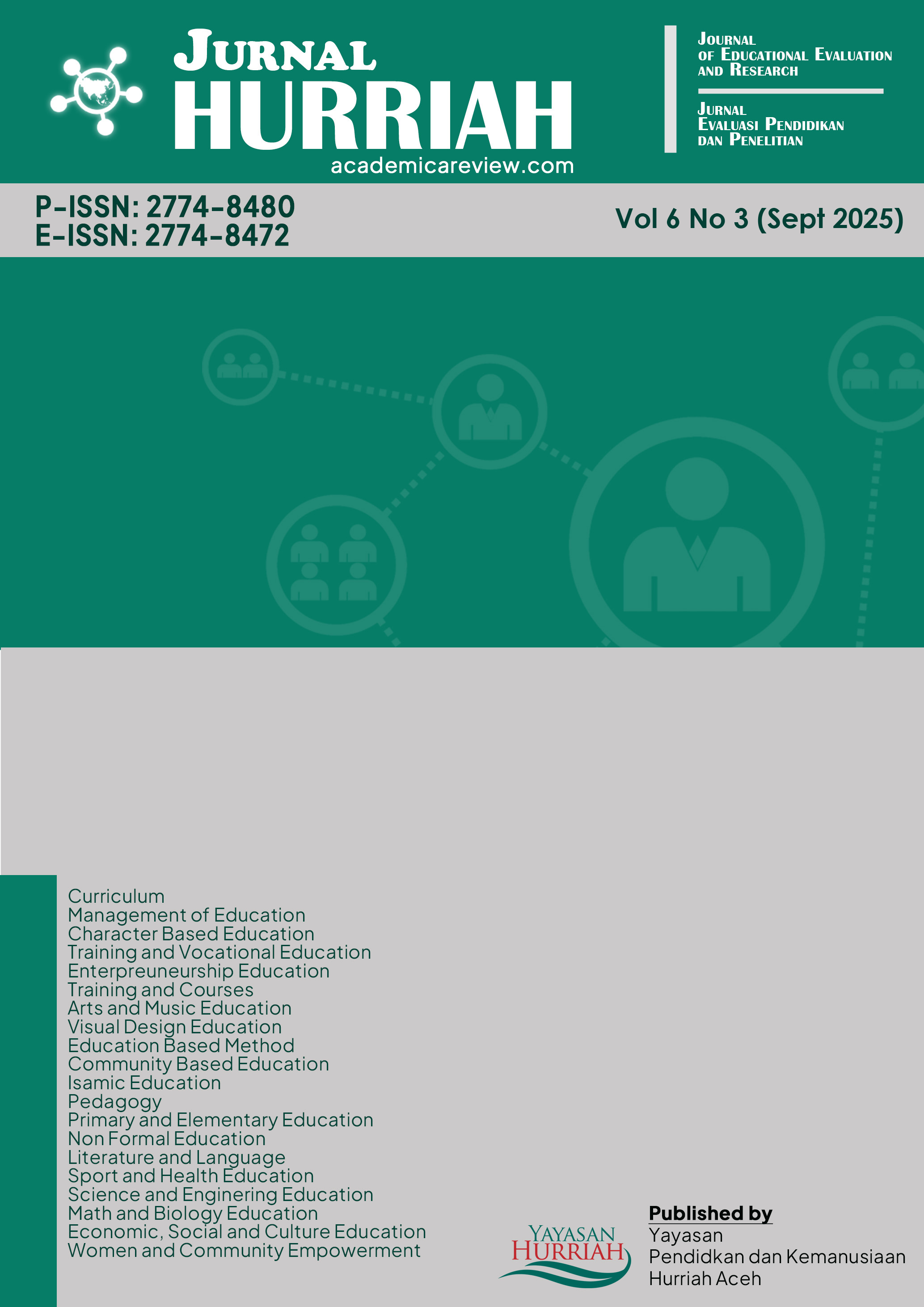
The September edition of Hurriah: Journal of Educational Evaluation and Research presents a set of evaluative studies addressing key issues in education, economics, finance, and socio-political dynamics in Indonesia. The articles examine market evaluation and product diversification in local industries, the impact of social media–driven political campaigns on democratic processes, and the role of financial literacy and ethical values in Sharia-compliant fintech and banking performance. Educational evaluation is further enriched through analyses of coaching-based academic supervision to enhance student well-being and pedagogical innovation in Islamic boarding schools through the Balaghah learning model. Collectively, these contributions highlight the importance of evidence-based, context-sensitive, and value-oriented research in strengthening institutional quality, educational practice, and societal development, reaffirming Hurriah’s commitment to advancing rigorous and relevant scholarly discourse.

Jurnal Hurriah: Journal of Educational Evaluation and Research proudly presents Volume 6, Number 2 (June 2025), which continues our commitment to advancing scholarly dialogue on education, leadership, organizational change, and community development within Indonesia’s diverse social landscape. This issue highlights the intersections of educational practice, religious thought, and socio-economic innovation, offering valuable perspectives for academics, practitioners, and policymakers.
The articles in this volume examine leadership and organizational management from multiple vantage points. One study investigates the influence of principal leadership on teacher performance in elementary schools in Banda Aceh, emphasizing the crucial role of school leadership in shaping teacher motivation, instructional quality, and student outcomes. Another contribution explores the management practices of Dayah Darul Fallah in North Aceh, providing insight into how Islamic boarding schools balance tradition and modern educational demands to strengthen institutional effectiveness.
Beyond education, this issue also addresses broader societal challenges. A thought-provoking article applies the framework of Maqashid Sharia to the pressing issue of climate change, focusing on its implications for the welfare of coffee farmers. By integrating religious principles with environmental sustainability, this research highlights pathways for empowering local communities through ethical and ecological considerations. Complementing this is an article analyzing the charismatic leadership of Abuya Amran Waly through Max Weber’s sociological lens, offering a deeper understanding of religious authority and its influence on community transformation.
Innovation and future-oriented education are also featured in a study on the training program at Alfata Islamic School in Banda Aceh. This program introduces students to the creative economy through the cultivation of Trigona bee honey, bridging traditional knowledge with entrepreneurial skills and fostering sustainability-oriented learning for younger generations.
Collectively, the studies presented in Volume 6, Number 2 illuminate the multifaceted nature of leadership, management, and innovation across Indonesia’s educational, religious, and industrial contexts. By combining theoretical reflection with practical application, they provide a roadmap for enhancing teacher performance, institutional resilience, community welfare, and sustainable development. We hope that the insights offered in this issue will inspire further research and contribute meaningfully to the ongoing discourse on education, leadership, and societal advancement.

This journal issue explores leadership, organizational change, and development in Indonesia’s education, religion, and industry sectors. It includes studies on principal leadership’s impact on teacher performance in Banda Aceh schools, and educational management at Dayah Darul Fallah in North Aceh. Other articles examine Maqashid Sharia in addressing climate change for coffee farmers’ welfare, and the charismatic leadership of Abuya Amran Waly using Max Weber’s framework. Additionally, a training program at Alfata Islamic School in Banda Aceh introduces students to the creative economy through Trigona bee honey cultivation. These studies offer insights for researchers and practitioners aiming to enhance education, sustainability, and innovation.
Published March 28, 2025

This issue explores innovative approaches to education, community empowerment, and socio-economic development, with a focus on addressing local challenges in Aceh. It covers diverse topics, including strategies for strengthening adolescent mental health in schools, youth empowerment through vocational training, the use of animated videos to foster creative thinking, solutions for educational challenges in dayah systems, identification of students’ misconceptions in science, linguistic challenges in English pronunciation, and the influence of halal and Islamic economic principles on consumer behavior. These studies collectively highlight the intersection of education, technology, and cultural values in fostering sustainable development.
Published December 28, 2024
Indexed by






This work is licensed under a Creative Commons Attribution-NonCommercial 4.0 International License.
